
Trucking profitability
How to Bid on Box Truck Loads Without Overlooking Costs
Build a box truck load bid from confirmed requirements, total costs and a clear margin target, then document the scope before acceptance.
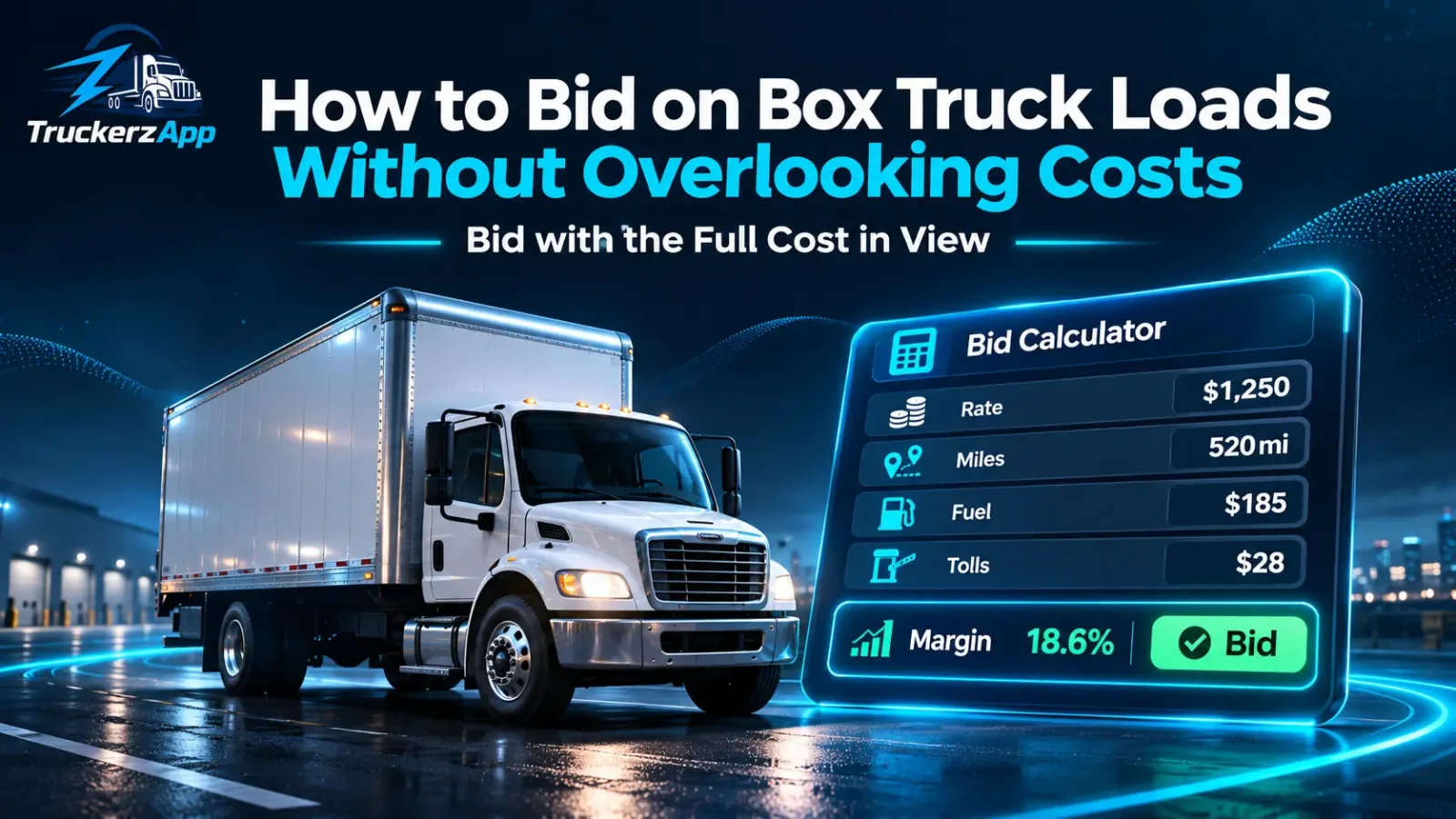
When you bid on box truck loads, the objective is to quote a service you can perform at an acceptable result for your business. Winning a shipment at any price is not a useful goal.
A disciplined bid begins with the scope, then the cost estimate, and finally the amount you are prepared to offer.
Define exactly what you are quoting
Confirm the addresses, appointments, commodity, dimensions, weight and loading method. Identify extra stops, liftgate use and driver-assist work.
Ask which details are still tentative. A quote for dock-to-dock service should not silently become a quote for several inside deliveries.
Document the assumptions so the other party can understand what the price covers.
Build the trip cost
Include approach miles, loaded miles and any required return or repositioning travel. Estimate time, driver cost, fuel, tolls, operating overhead and applicable fees.
Use consistent cost definitions. If an all-in mileage estimate already includes fuel and maintenance, avoid adding them again as separate full costs.
Calculate a range when important inputs remain uncertain, and resolve the uncertainty before committing where possible.
Understand markup and margin
Suppose a hypothetical trip has an estimated total cost of $600. Adding a 20% markup produces a $720 quote.
A 20% margin on revenue is different. To leave 20% of the quoted revenue after that $600 cost, the calculation is $600 divided by 0.80, or $750.
Neither percentage is a recommended market rate. The example simply shows why your team needs to agree on which calculation it is using.
If a fee is a percentage of revenue, include it consistently in the model rather than overlooking it.
Present a clear offer
State the rate, service scope, equipment and availability. Identify any conditions that need confirmation, such as the appointment or final shipment dimensions.
Do not treat silence as acceptance. Confirm the booking through the agreed process and check the written confirmation before dispatching.
If the scope changes, review the price and capacity again rather than absorbing an unknown obligation.
Learn from accepted and rejected bids
Record why an offer was declined when that information is available. Separate price objections from equipment, timing or eligibility problems.
For accepted loads, compare estimated and actual costs. A strong bidding process improves from completed trips, not just from how many offers are accepted.
Use the TruckerzApp load profit calculator to test the economics, then keep the final instructions and paperwork attached to the load. The right bid is one that your operation can execute responsibly under clearly understood terms.