
Trucking profitability
How Much Do Box Truck Loads Pay? Revenue vs. Profit Explained
Understand why box truck load payments vary and how to separate gross revenue, operating margin and cash received using your own trip records.
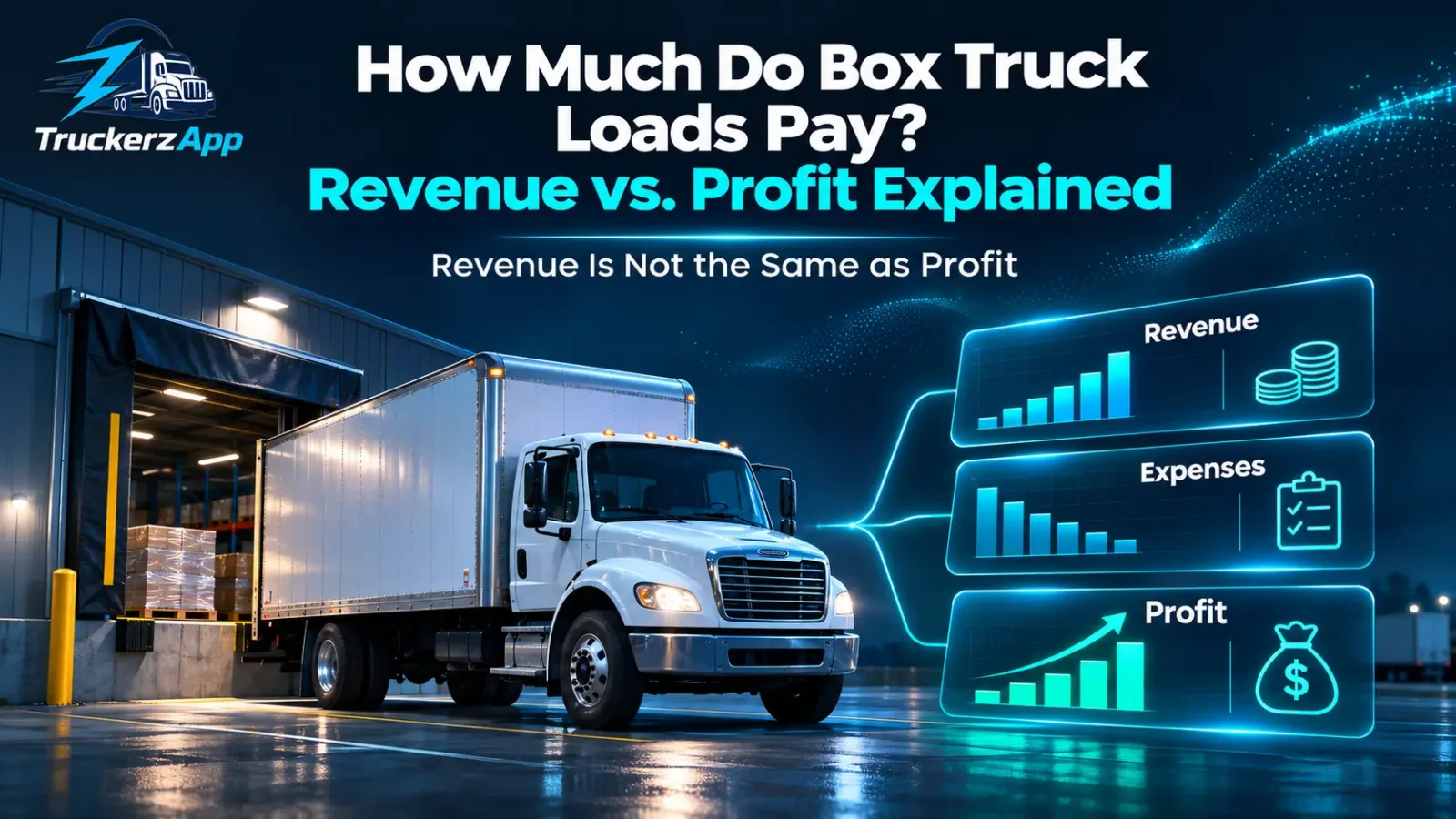
There is no single payment figure that represents every box truck load. Distance, equipment requirements, timing, service level and the parties' agreement all affect the amount offered.
The better question is how much a particular load leaves after the costs of completing it. A screenshot of gross revenue cannot answer that question on its own.
Separate three different numbers
Gross revenue is the amount earned for the agreed service before expenses.
Operating margin is what remains after the costs included in your calculation. It is only meaningful if you know which expenses have been counted.
Cash received is the money that arrives in your account and when it arrives. It can differ from gross revenue because of deductions, fees or outstanding payments.
Treating these numbers as interchangeable makes it difficult to judge whether the business is performing well.
Look beyond the loaded distance
A $600 load may look attractive over 150 loaded miles. If it requires 150 empty miles to pickup and a long wait, the picture changes.
In that hypothetical example, the revenue is $4.00 per loaded mile but $2.00 per mile across the 300-mile approach and loaded trip. Any required repositioning afterward would add more distance.
The payment has not changed. The amount of work needed to earn it has.
Estimate the costs before accepting
Include fuel, driver compensation, maintenance allowance, tolls and any applicable service fees. Allocate fixed operating costs using a consistent method so they do not disappear from the calculation.
For illustration only, suppose the $600 trip has $420 of total allocated costs. The estimated remaining amount is $180 under those assumptions. Omitting a $100 cost would make the apparent result look $100 better without improving the business.
The cost-per-mile calculator can help organize your inputs. Use actual records wherever possible.
Understand how service requirements affect the quote
A load involving several stops, restricted appointments or special handling is not directly comparable with a straightforward dock-to-dock shipment.
Confirm the complete scope. Ask how additional work is authorized and documented. Do not assume a quoted amount includes services that were never discussed.
When someone quotes an earnings figure, ask whether it is per load, per day or per week, and whether expenses have been deducted.
Build a reliable history
Review completed loads by total miles, hours occupied, expenses and payment status. Keep the supporting paperwork available so the figures can be checked.
Use the load profit calculator before booking, then compare the estimate with the finished trip. This gives your fleet a practical basis for decisions without depending on promises about what every box truck “should” earn.